As the first Black female TV journalist in the West, she didn’t just report the news—she helped change the face and focus of American journalism, bringing untold stories into the light with charisma, professionalism, and fierce determination.
After growing up in Oakland, California, Davis began writing freelance articles for magazines in 1957. Within a few years, she began reporting on radio and television. As a reporter, Davis covered many important events of the day, including issues of race, gender, and politics. She became an anchorwoman and hosted her own talk show, before retiring in 2012.
Belvagene Melton was born in Monroe, Louisiana, on October 13, 1932. She was the oldest of four children. Her mother was 14 years old at Belva's birth, and Belva spent her early years living with various relatives.
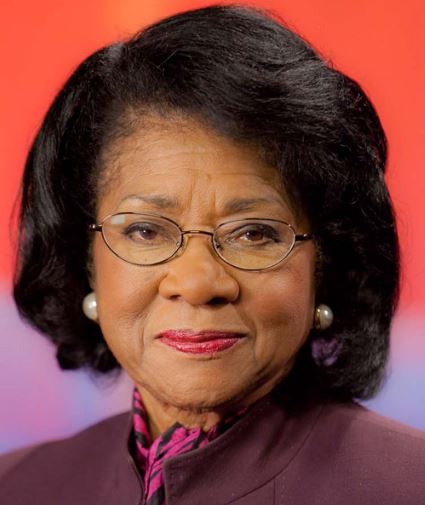
Belva was just eight years old. By the time she graduated from Berkeley High School in 1951—becoming the first in her family to earn a diploma—Belva was essentially on her own.
When she was eight years old, Belva and her family, including aunts and cousins, moved to a two-bedroom apartment in the West Oakland neighborhood of Oakland, California. Eleven people lived in the apartment. Belva later said about her youth, "I learned to survive. And, as I moved from place to place, I learned to adapt. When I got older, I just figured I could become whatever it was that I needed to become."
“I wanted to broadcast the reality of my community to those who could not otherwise imagine it, to fill in that missing perspective,” Belva wrote in her memoir.
Her incisive interviews defined her career. She sat down with countless influential figures, including an impassioned James Baldwin, Dr. Martin Luther King Jr., Fidel Castro, Frank Sinatra, Alex Haley, and every president from Ronald Reagan to George Bush. She interviewed Muhammad Ali. Many times, she interviewed Willie Brown, first when he was a young assemblyman, then as Speaker of the State Assembly, and finally as Mayor of San Francisco.
“Belva was not only the best journalist I ever knew, she was one of the absolute finest human beings,” said Brown. “She could disarm you with that wry smile and beautiful voice, but then her questions could cut to the bone!”
Her influence extended far beyond the newsroom. A passionate advocate for the arts, she served on the boards of the SF War Memorial & Performing Arts Center, the Fine Arts Museum of San Francisco de Young/Legion of Honor, and she spearheaded the development of the Museum of the African Diaspora, securing $5 million in funding in a single year.
Belva was equally a force for change within her industry. She was an advocate for equal opportunity and visibility for women and people of color. A fierce union member, she was the national chair for equal employment opportunities at AFTRA (now SAG-AFTRA). She fought Hollywood producers for the inclusion of African Americans in theatrical productions and helped establish the 40-hour workweek for reporters.
Her mantle of accolades includes eight Emmy Awards, the International Women’s Media Foundation’s Lifetime Achievement Award, induction into the National Association of Black Journalists Hall of Fame, the Radio Hall of Fame, and the California Hall of Fame.
Always a strong advocate for education, she was recognized by Golden Gate University, JFK University, Academy of Art University, and Sonoma State University with Honorary Doctorate degrees.
Former Vice President Kamala Harris called her “an inspiration.” “Today’s black journalists walk in Belva’s footsteps,” said “60 Minutes” reporter Bill Whitaker.
By the late 1940s, her parents were able to afford a house in Berkeley, California. Belva graduated from Berkeley High School in 1951, becoming the first member of her family to graduate from high school. She applied and got accepted into San Francisco State University but couldn't afford to attend college. She went to work as a typist at the Oakland Naval Supply Depot, earning $2,000 a year.
Belva accepted a freelance assignment in 1957 for Jet, a magazine focusing on African-American issues, and became a stringer for the publication. She received $5 per piece with no byline. Over the next few years, she began writing for other African-American publications, including the Sun Reporter and Bay Area Independent. Belva edited the Sun Reporter from 1961 through 1968.
In 1961, Belva became an on-air interviewer for KSAN, a San Francisco AM radio station broadcasting a rhythm and blues music format, targeting black listeners in the Bay Area. She made her television debut in 1963 for KTVU, an Oakland-based television station, covering an African-American beauty pageant. She worked as a disc jockey for KDIA, a soul-gospel radio station (also based in Oakland) when the 1964 Republican National Convention, located at the Cow Palace in nearby Daly City, California, inspired her to become a reporter.
According to Belva's account, while she was covering the convention with Louis Freeman, the two were chased out of the Cow Palace by convention attendees throwing food at them and yelling racial slurs. It would not be the last time she encountered racism on the job: In 1967 she covered a march during the Civil Rights Movement in Forsyth County, Georgia, and attempted to interview a white woman who spat in her face.
Belva worked for KNEW, an AM radio station located in Oakland, as an announcer in 1966She became the first female African-American television journalist on the West Coast when she was hired by KPIX-TV, the CBS affiliate based in San Francisco, in 1966.She spent the next three decades working in Bay Area television, first for KPIX (becoming an anchorwoman in 1970), and a few years later moved to what was then the local NBC affiliate, KRON-TV.Stories she covered include the Berkeley riots of the Free Speech Movement, the Black Panthers, the mass suicide-murder at Jonestown, the Moscone–Milk assassinations, the AIDS and crack epidemics, and the 1998 United States embassy bombing in Tanzania.
For 18 years beginning in 1981, she and Rollin Post co-hosted the KRON's Sunday-morning show "California This Week"
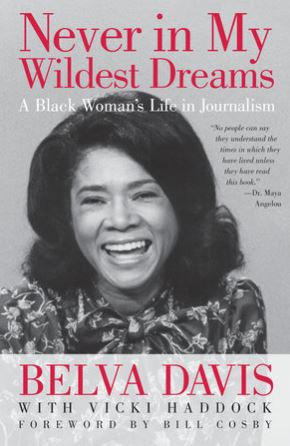
Her autobiography, entitled Never in My Wildest Dreams: A Black Woman's Life in Journalism, was published in 2010.
Belva hosted "This Week in Northern California" on PBS member station KQED, starting in the 1990s. She retired in November 2012. Her final broadcast included a taped interview with Maya Angelou, a personal friend, as she wanted the theme of her final show to be friendship.
Belva was highly regarded for her coverage of politics and issues of race and gender, as well as her calm demeanor. Rita Williams, a reporter for KTVU, said "Belva knew instinctively how to keep everyone in check. Amid all these prima donnas, she had so much class, so much presence, so much intuition. Belva has always been the grande dame."
Belva Davis, a private person, separated her personal life from her professional life for most of her journalistic life.
Belva Davis passed away peacefully after a long illness, just a few weeks shy of her 93rd birthday. She leaves behind a legacy of strength, intelligence, professional excellence, and an unwavering commitment to serving others.